Closing Off an Archway or Room: Framed Door, Pocket Door or Barn Door?
Three ways to put a door where there was only an opening, and what each one asks of your wall.
October 20, 2026 · 4 min read
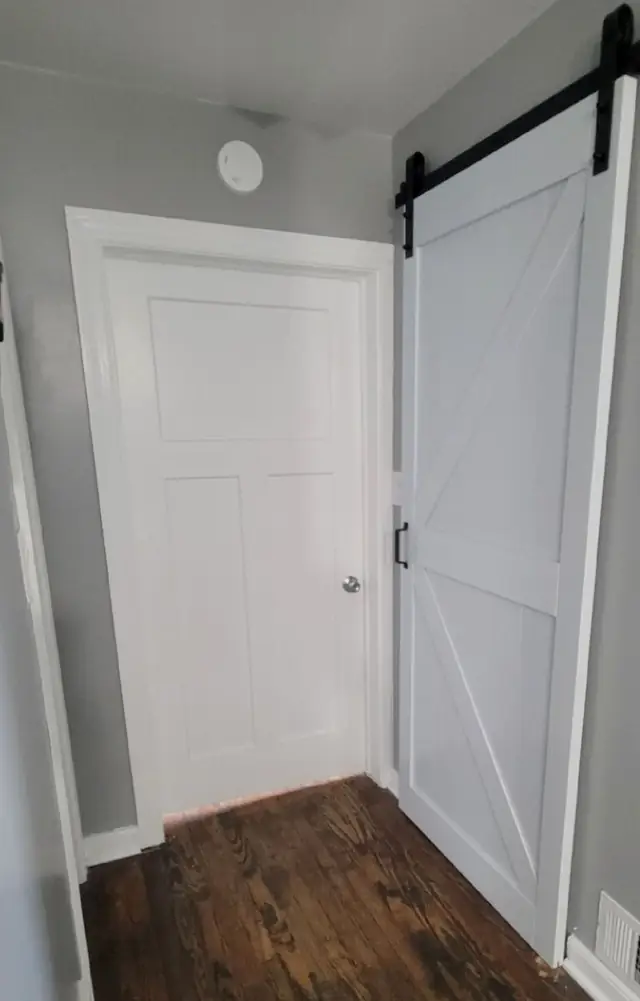
Open plans are lovely until you need a quiet room. Maybe the dining room has become a home office, or a den has turned into a bedroom for a parent who has moved in. Maybe you simply want the kitchen smells and noise to stay put. An archway or a wide opening is easy to live with and hard to close. There are three common ways to add a door, and each one suits a different kind of room. Here is how they differ in daily use and in the work needed to install them.
The framed door: still the default
A regular hinged door in a framed opening is the most private option. It seals the edges, blocks the most sound and light, and works in any room. The cost of that is the swing. The door needs a clear arc, and the space it sweeps cannot hold a chair, a dresser or a radiator. Converting an archway to a standard door also means framing: building the opening down to the right width and height, setting a proper jamb and trimming it so the new door looks like it was always there. It is the most work of the three, and the most finished-looking when done well.
The pocket door: the space saver
A pocket door slides into a cavity inside the wall and disappears. That makes it ideal for tight spots like a bathroom, a closet or a hallway where a swinging door would hit something. It closes cleanly and gives good privacy. The catch is that the wall has to be opened and rebuilt around a track and a hollow pocket for the door. That wall cannot hold wiring, plumbing or a heating run in the way, and if it does, those have to be moved first. A pocket door also needs the hardware to be reachable, because the track and rollers will eventually need adjusting. Done carefully, it is a clean, long-lasting solution.
The barn door: easy on the wall, not on privacy
A barn door hangs on a track mounted above the opening and slides along the face of the wall. It is the simplest of the three to install, because nothing is built inside the wall, and it can look striking in a house with some character. But a barn door sits slightly proud of the wall and never seals the edges, so sound and light leak around it. It also needs a clear stretch of wall beside the opening, about as wide as the door itself, with no furniture, switches or outlets in its path. For a home office, a den or a laundry nook, that trade is often fine. For a bathroom or a bedroom where privacy matters, it usually is not.
One more point about barn doors: the track carries the full weight of a heavy door and everything a hand pushes against it. It has to be fastened into solid framing or blocking behind the drywall, never just into the wall surface. A door that looks fine on day one can pull out of a wall that was never meant to hold it.
Questions to ask before you choose
- How much privacy does this room need? Sound and light matter more than looks for a bedroom or an office
- What is on the wall beside the opening? Outlets, switches, thermostats and shelves all affect a barn door
- What is inside the wall? A pocket door needs a wall that is free of wiring and pipes, or one that can be rerouted
- How much room does a swinging door get? If the answer is none, think pocket
- Does the opening need to be reshaped? Arches have curved tops, and a door needs a square head
- Does a township permit apply to any of it? It is worth asking before the wall is opened
A word on archways specifically
An arched opening is a design feature, and filling it in changes the look of the room. The curved top has to be squared off with framing, then finished so that the new header, trim and paint match the rest of the room. Done thoughtfully, a former archway can look like it was always built as a doorway. Done quickly, it looks like a patch. If you are considering a conversion, it helps to think of the door and the trim as one design, not two separate jobs.
HandyMac has converted archways to doors, hung barn doors and installed pocket doors for homeowners in Telford and across Montgomery and Bucks County. Joel MacLeod works under PA contractor license PA180140 and is fully insured. Call or text 908-296-9261, send a photo of the opening, and he can help you decide which kind of door your wall can handle.
HandyMac Home Services LLC, 908-296-9261
Call 908-296-9261More articles
How to Build a Repair List One Handyman Visit Can Clear
Twenty minutes with a pen turns a head full of nagging repairs into a single, finished visit.
Grab Bars and Wider Doorways: Making a Home Easier to Move Through
A few well-placed bars and one wider opening can change how a house feels to someone who is unsteady on their feet.